
Introduction
In today’s fast-moving manufacturing world, efficiency, accuracy, and scalability define success, and repmold has emerged as a practical solution that meets all three demands. Manufacturers across industries now rely on advanced molding methods to reduce errors, shorten production cycles, and maintain consistent quality without inflating costs. This guide explores how this approach works, why it matters, and how businesses can benefit from adopting it strategically.
Understanding the Concept Behind Modern Replication Molding
At its core, repmold refers to a refined manufacturing process designed to replicate components with extreme precision while maintaining structural consistency across repeated production cycles. Unlike traditional molding techniques that often require frequent recalibration, this method focuses on stability, repeatability, and reduced material waste.
The process begins with a master model that defines every critical dimension. From this model, molds are produced that can replicate the original design with minimal deviation. This controlled approach ensures each final product mirrors the original intent, even at higher volumes.
Why This Manufacturing Method Matters Today
As global markets demand faster delivery and tighter tolerances, repmold offers a balance between speed and reliability. Manufacturers benefit from reduced tooling errors and fewer rejected parts, which directly impacts profitability and brand trust.
Key drivers behind its growing adoption include:
-
Consistent quality across batches
-
Lower long-term production costs
-
Faster turnaround times
-
Improved material efficiency
These advantages make it particularly valuable for industries where precision is non-negotiable.
Newtopy Explained: A Smart Shift in Modern Digital Thinking
Key Benefits for Manufacturers and Product Designers
One of the most significant advantages of repmold lies in its ability to support both prototyping and scaled production. Designers can test iterations quickly while manufacturers maintain confidence that final outputs will remain consistent.
Additional benefits include:
-
Enhanced surface accuracy
-
Predictable production outcomes
-
Reduced dependency on constant manual adjustments
-
Better alignment between design intent and final output
This alignment strengthens collaboration between engineering and production teams, minimizing costly redesigns.
Comparison Chart: Traditional Molding vs Advanced Replication Molding
| Feature | Traditional Molding | Advanced Replication Molding |
|---|---|---|
| Precision Control | Moderate | High |
| Material Waste | Higher | Minimal |
| Setup Time | Long | Short |
| Repeatability | Inconsistent | Highly consistent |
| Cost Efficiency | Variable | Predictable |
| Scalability | Limited | Strong |
This comparison shows why repmold is increasingly preferred when quality and efficiency must coexist.
Industries That Benefit the Most
Several sectors rely heavily on repmold due to strict performance and quality requirements. These include:
-
Automotive manufacturing for consistent component geometry
-
Medical production where accuracy impacts safety
-
Consumer electronics requiring compact and precise parts
-
Industrial equipment needing durable and repeatable components
In each case, reliable replication helps reduce failure rates and improve customer satisfaction.
Quality Control and Reliability Factors
Quality assurance plays a central role in successful molding operations. With repmold, manufacturers implement structured inspection processes that monitor dimensional accuracy, surface finish, and material integrity.
By integrating automated measurement tools and standardized testing protocols, production teams ensure every unit meets defined specifications. This systematic control reinforces trust across supply chains and end users.
Cost Efficiency and Long-Term Value
While initial setup may require careful planning, repmold delivers strong long-term financial advantages. Reduced waste, fewer rejected parts, and lower maintenance needs translate into sustainable savings over time.
More importantly, predictable production costs help businesses forecast budgets accurately and respond confidently to market demands without unexpected expenses.
Frequently Asked Questions
1. What makes repmold different from standard molding?
It focuses on consistent replication with minimal variation, ensuring each produced part matches the original design accurately.
2. Is this method suitable for small production runs?
Yes, it supports both limited batches and large-scale manufacturing with equal reliability.
3. Does it reduce material waste?
The controlled process minimizes excess material use and lowers rejection rates.
4. How does it improve product quality?
By maintaining dimensional stability and surface accuracy across repeated cycles.
5. Can it support complex designs?
Yes, it handles intricate geometries more reliably than conventional methods.
Conclusion
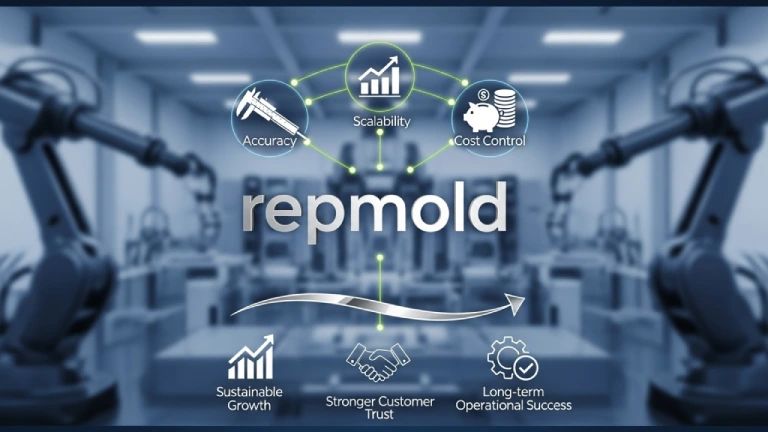
In an era where manufacturing precision defines competitiveness, repmold stands out as a reliable, efficient, and future-ready solution. By combining accuracy, scalability, and cost control, it empowers manufacturers to meet modern demands without compromising quality. Businesses that adopt this approach position themselves for sustainable growth, stronger customer trust, and long-term operational success.